COVID Origins & Accountability
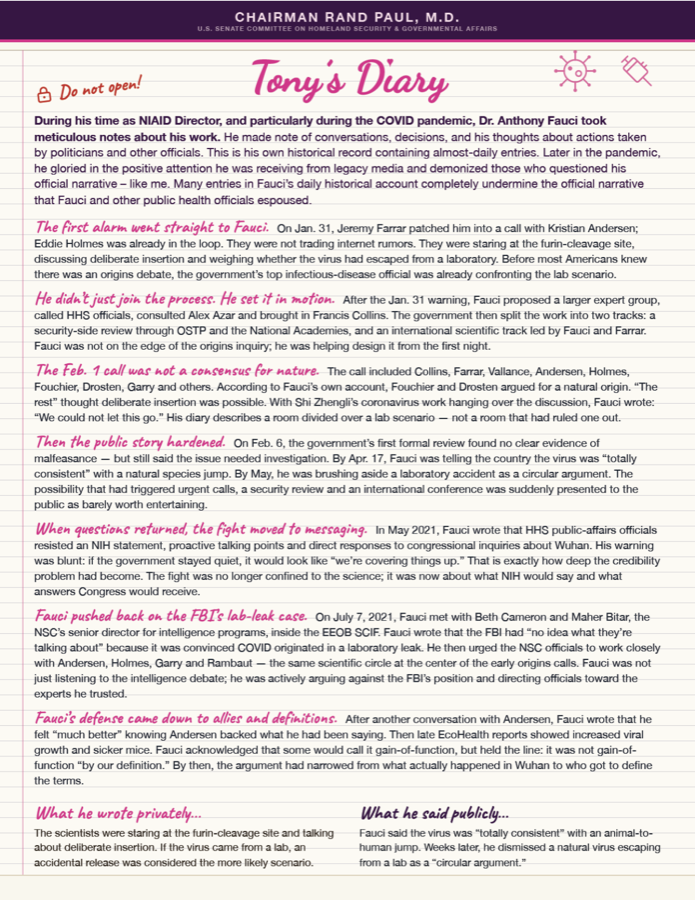
Sen. Rand Paul's committee has released Dr. Anthony Fauci's personal daily journals. They document what Fauci knew about COVID's origins, when he knew it, and how different it was from what he told the public.
During his time as NIAID Director, Dr. Anthony Fauci kept meticulous daily journals. He recorded conversations, decisions, and his thoughts on the actions of politicians, colleagues, and the press — with near-daily entries throughout the COVID pandemic. His diary is now public, released by the U.S. Senate Committee on Homeland Security and Governmental Affairs under Chairman Rand Paul.
It runs to hundreds of pages. And what it shows is a gap between two parallel stories: the one Fauci told the American public, and the one he wrote down for himself.
On January 31, 2020, Dr. Jeremy Farrar — director of the Wellcome Trust — got off a routine call with Fauci about the emerging Wuhan outbreak, then immediately patched Fauci back into a second call. On the line: Dr. Kristian Andersen, an evolutionary biologist at Scripps Research, and Dr. Eddie Holmes from Sydney. They were not trading internet rumors.
Fauci's diary records what they were actually discussing — the furin cleavage site of the SARS-CoV-2 genome. This structural feature had no close parallel in known bat coronaviruses. The scientists on the call raised the possibility that it could not have occurred naturally and may have been deliberately inserted. They discussed whether the virus had escaped from a laboratory, and whether the release was accidental or intentional — with accidental release considered the more likely scenario if it was a lab origin at all.
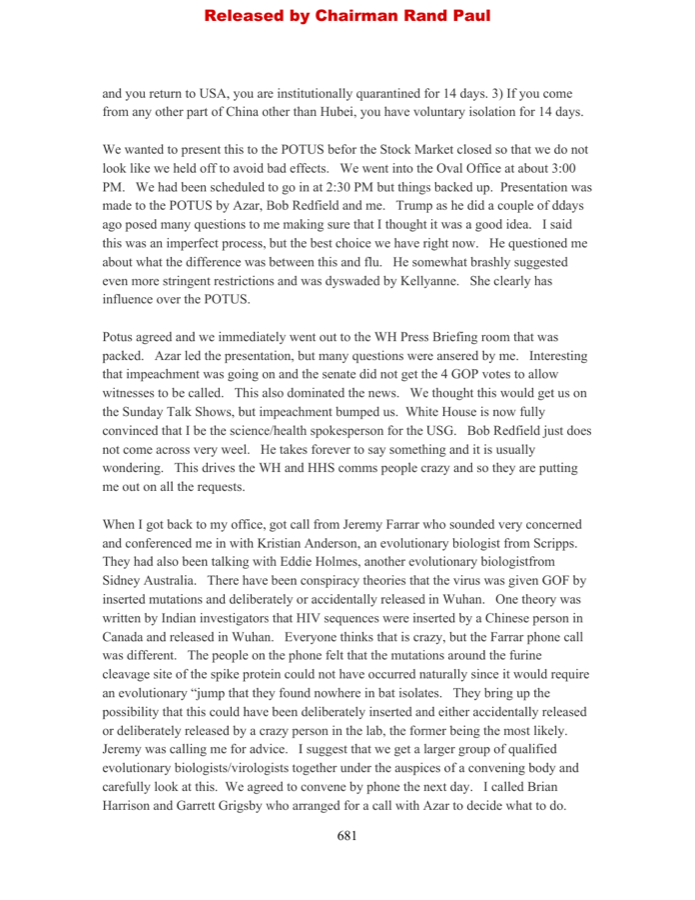
"They bring up the possibility that this could have been deliberately inserted and either accidentally released or deliberately released by a crazy person in the lab, the former being the most likely." — Fauci's diary, Jan. 31, 2020
This happened before most Americans knew there was an origins debate. Fauci was in the room — not as a passive bystander, but as the person Farrar called for advice. His diary records that he immediately suggested getting a larger group of qualified virologists together and convening the next day. He then called HHS officials, consulted Secretary Azar, and brought in Francis Collins.
The next morning, February 1, 2020, Fauci and Francis Collins convened an emergency teleconference. Participants included Collins, Farrar, Patrick Vallance, Andersen, Holmes, Ron Fouchier, Christian Drosten, Robert Garry, and others.
This call has been described, and its aftermath used to suggest, that the scientific community quickly reviewed the evidence and concluded the virus was not lab-made. Fauci's own diary says something different.
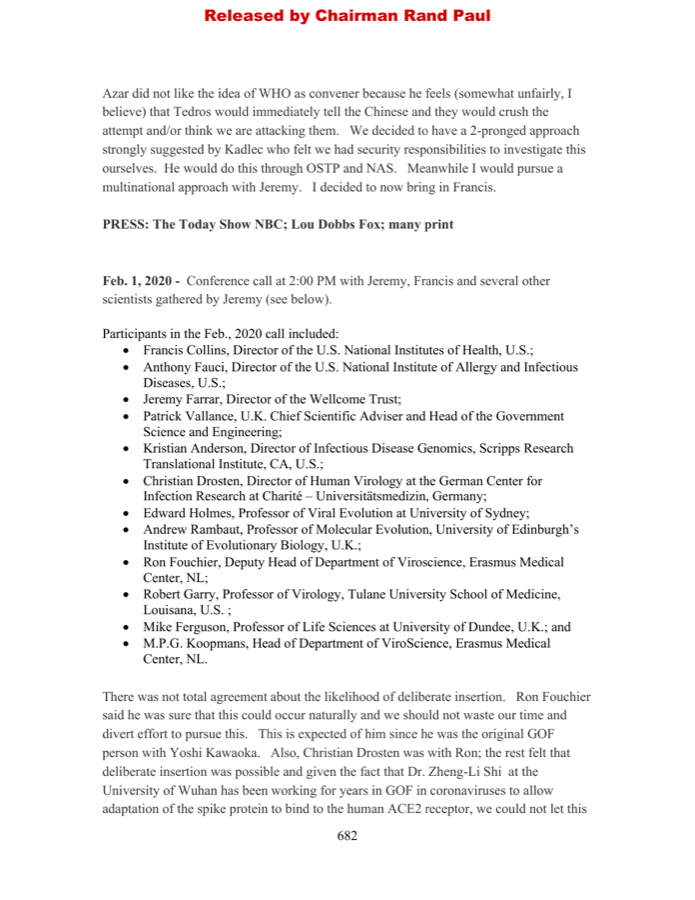
"There was not total agreement about the likelihood of deliberate insertion. Ron Fouchier said he was sure that this could occur naturally… The rest felt that deliberate insertion was possible and given the fact that Dr. Zheng-Li Shi at the University of Wuhan has been working for years in GOF in coronaviruses… we could not let this go." — Fauci's diary, Feb. 1, 2020
Fouchier and Drosten argued for natural origin. "The rest" — Fauci's phrase — thought deliberate insertion was possible. Fauci wrote: "We could not let this go." The room was divided. The Proximal Origin paper, which publicly declared that "no laboratory-based scenario was plausible," was submitted four days later.
On February 6, 2020, the government completed its first formal review of the origins question. According to Rand Paul's committee summary, it found no clear evidence of malfeasance — but explicitly concluded the issue still needed investigation.
By April 17, 2020, Fauci was publicly telling the country the virus was "totally consistent" with a natural species jump. By May, he was dismissing the lab-leak hypothesis as a "circular argument."
The diary captures a widening gap: an internal review that said keep investigating, and a public-facing Fauci increasingly confident that the question was settled.
By May 2021, congressional investigators had begun asking about the NIH's role in funding research at the Wuhan Institute of Virology. Fauci's diary records that HHS public-affairs officials resisted putting out a proactive NIH statement with direct responses to those congressional inquiries.
Fauci's own private assessment of that silence is striking:
"If the government stayed quiet, it would look like 'we're covering things up.'" — Fauci's diary, May 2021
That is Fauci's private read of what NIH's communications strategy looked like from the outside. It is either a warning he was trying to prevent — or a description of exactly what was happening.
On July 7, 2021, Fauci met with Beth Cameron and Maher Bitar — the NSC's senior director for intelligence programs — inside the EEOB Sensitive Compartmented Information Facility (SCIF). The FBI, by this point, had assessed that COVID-19 most likely originated in a laboratory.
Fauci's diary is blunt about his view of that conclusion:
"It became clear that the FBI has no idea what they're talking about since they are convinced that COVID originated in a laboratory leak." — Fauci's diary, July 7, 2021
He then urged NSC officials to work closely with Andersen, Holmes, Garry, and Rambaut — the same circle of scientists at the center of the early origins calls, and the co-authors of Proximal Origin. Fauci was not just privately skeptical of the FBI's conclusion. He was actively steering intelligence officials toward the same scientific allies who had shaped the public narrative.
Around May 2021 — the same month Fauci warned that staying quiet would look like a cover-up — he had a private conversation with Kristian Andersen. This is the same Andersen who, in January 2020, had privately written that the lab-escape hypothesis was "so friggin' likely to have happened."
A year later, Andersen was privately reassuring Fauci. According to the diary, Andersen was "very emphatic" that the work done at the Wuhan Institute under the NIH grant was not gain-of-function research, and confirmed that chimeric viruses made under that grant were "not even close sequence-wise" to SARS-CoV-2.
"I feel much better now that he is in total support of what I have been saying." — Fauci's diary, May 2021
The same scientist. A year apart. First privately alarmed. Then privately reassuring. What changed in between was the publication of Proximal Origin — the paper Andersen co-authored that declared the lab origin implausible.
In August 2020, President Trump brought in Dr. Scott Atlas — a radiologist and health policy fellow at Stanford's Hoover Institution — as a White House special assistant. Atlas argued that schools could and should reopen, that children did not drive community spread, and that lockdowns caused more harm than they prevented.
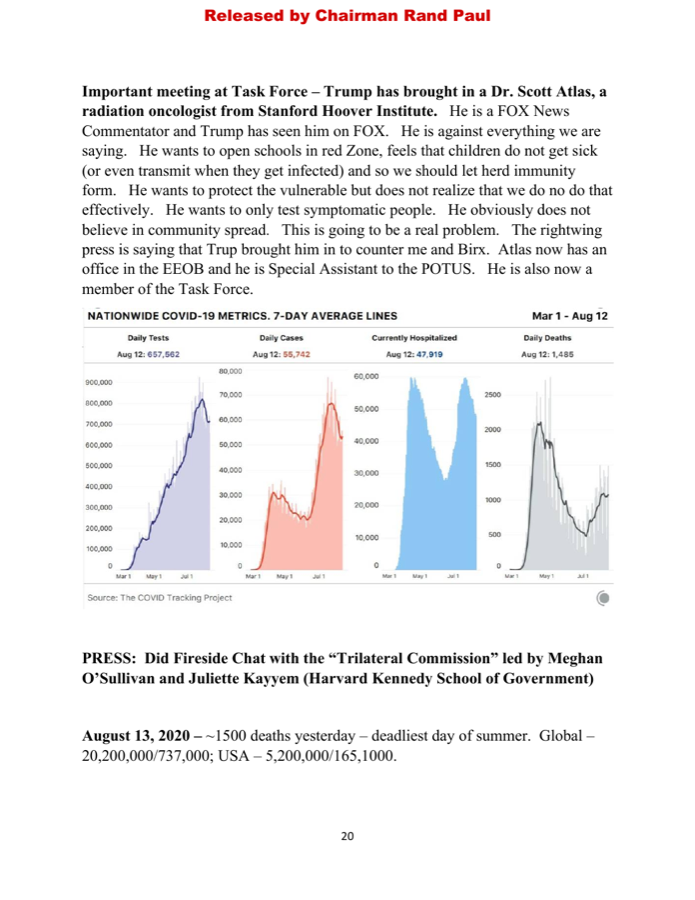
Fauci's diary entry on Atlas's arrival frames the dispute in political and credentialing terms, not scientific ones:
"Trump has brought in a Dr. Scott Atlas, a radiation oncologist from Stanford Hoover Institute. He is a FOX News Commentator and Trump has seen him on FOX. He is against everything we are saying… He obviously does not believe in community spread. This is going to be a real problem." — Fauci's diary, August 12, 2020
The conflict intensified through the fall. In late October, Fauci gave a Washington Post interview in which he, by his own diary account, "strongly blasted Scott Atlas." The White House pushed back. Alyssa Farah, a senior White House aide, texted Fauci at 7 AM the next morning:
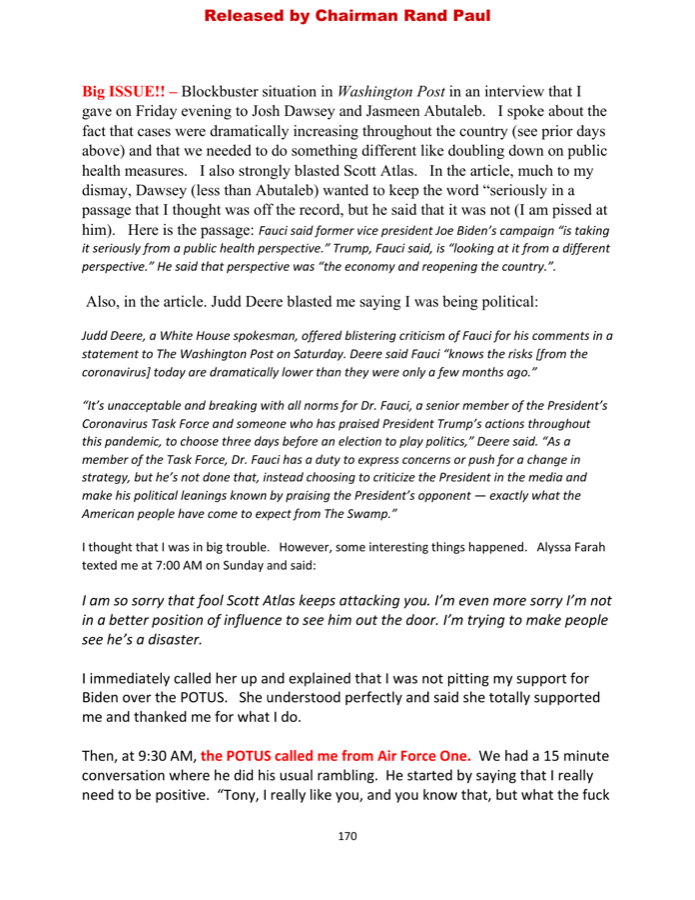
"I am so sorry that fool Scott Atlas keeps attacking you. I'm even more sorry I'm not in a better position of influence to see him out the door. I'm trying to make people see he's a disaster." — Alyssa Farah, quoted in Fauci's diary
Atlas resigned in December 2020. Fauci's diary entry on the resignation is telling:
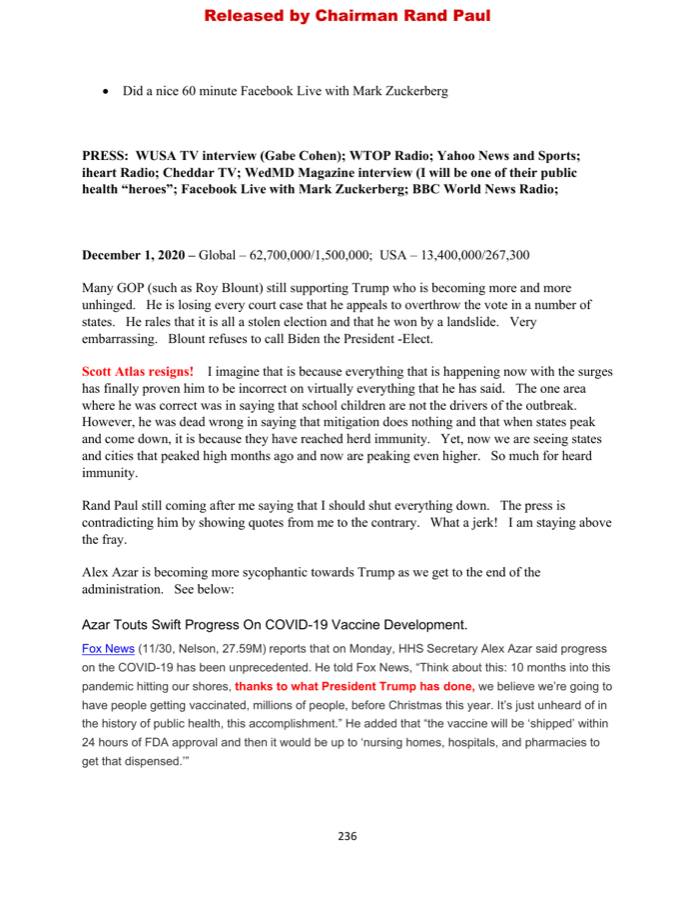
"Scott Atlas resigns! I imagine that is because everything that is happening now with the surges has finally proven him to be incorrect on virtually everything that he has said. The one area where he was correct was in saying that school children are not the drivers of the outbreak." — Fauci's diary, December 1, 2020
Atlas was publicly dismissed, mocked in the press, and branded a fringe figure. Fauci's private diary concedes that Atlas was right about the thing parents cared about most — whether keeping kids out of school made any difference.
Scientists were staring at the furin cleavage site and discussing deliberate insertion. If the virus came from a lab, an accidental release was considered the more likely scenario. The Feb. 1 call room was divided. The FBI concluded lab leak. He pushed back.
The virus was "totally consistent" with an animal-to-human jump. The lab-leak hypothesis was a "circular argument." The scientific community had reviewed the evidence and reached a conclusion.
The case for trusting public health officials rests on a simple premise: they follow the science wherever it leads, and they tell you what they actually know. Fauci's diary shows a more complicated picture.
From the very first night — January 31, 2020 — Fauci was aware of serious scientific uncertainty about COVID's origins. He helped organize the scientific response to that uncertainty. He was in the room when the room was divided. He privately acknowledged that staying quiet looked like a cover-up. He actively argued against the FBI's lab-origin conclusion and directed officials toward the scientists who had built the public narrative. And when his key ally privately reassured him a year later, he wrote that he felt "much better."
None of this required a leaked document or a whistleblower. It was all in his diary.
The documents are public. The emails are public. The diary is public. You can read it yourself.
Sources: Fauci's personal diary, released July 24, 2026, by the U.S. Senate Committee on Homeland Security and Governmental Affairs, Chairman Rand Paul. All diary excerpts are quoted directly from the released text. The RationalGround COVID-FOIA Evidence Database indexes key findings from this document under the tag tony-diary.